
A Multi-Generational Diné Women Empowerment Portrait Session in Ganado, Arizona
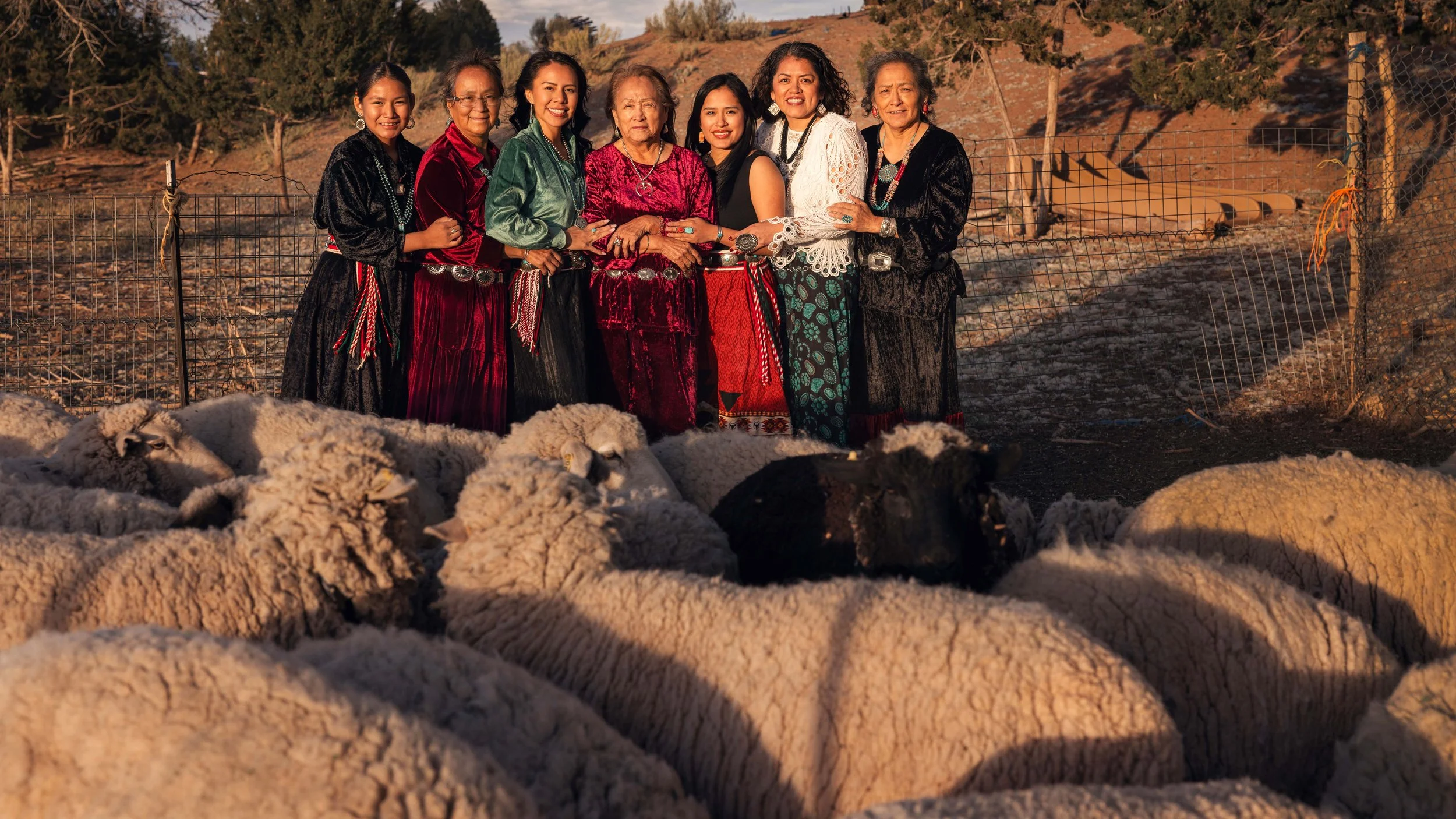
Multi-generational portrait of Diné women gathered with sheep on family land in Ganado, Arizona, for Kim Brundage’s Diné Women Empowerment Series.
As my Diné Women Empowerment Series continues to grow, I have been paying attention not only to who is already in the work but also to where the series is still leading me.
Recently, I realized the series needed something more.
It needed a young girl.
It needed a visible thread between generations. It needed to show not only womanhood, but inheritance. It needed to hold the tenderness of becoming alongside the strength, wisdom, and lived experience of the women who came before.
Before I share more, I want to say this clearly: I am not speaking for Diné people, nor am I trying to explain a culture that is not mine.
I am still learning and will always be learning.
My role in this project is to listen, witness, research, build relationships, and create portraits with care and respect. Every session teaches me something new, and I approach this work with deep humility and gratitude for the women and families who choose to share a piece of their story with me.
This session was photographed on the family’s land in Ganado, Arizona, as part of my ongoing Diné Women Empowerment Series, a portrait project rooted in listening, relationship, humility, and respect.
That realization led me back to Tiana, the first woman I photographed for this series in the Bisti Badlands.
I reached out, shared what I was envisioning, and she graciously agreed.
We set an April date.
And what unfolded became one of the most meaningful chapters of the project so far.
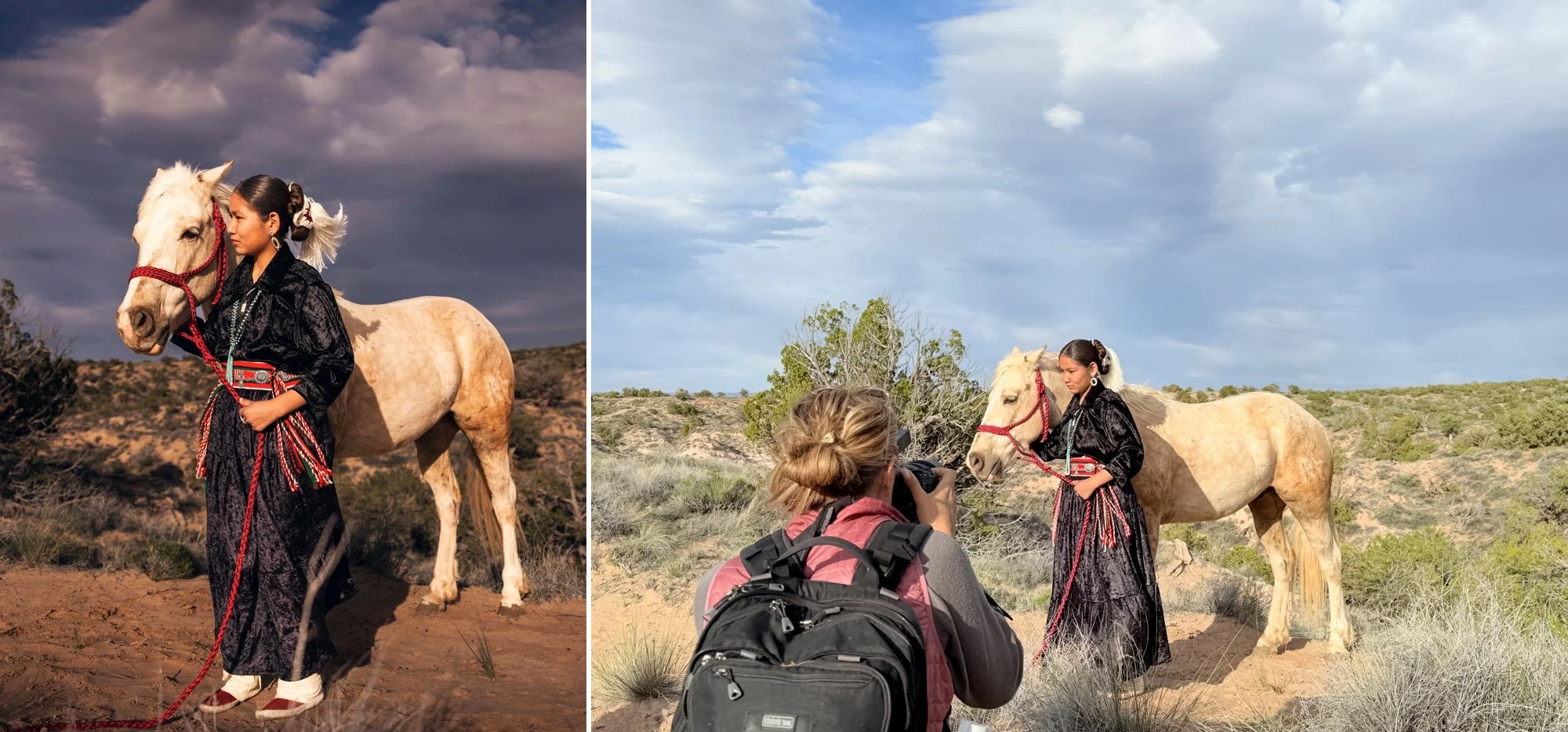
Nicolette, Tiana’s 10-year-old niece, photographed with a rescued horse on family land in Ganado, Arizona.
Returning to Tiana
There was something especially meaningful about returning to Tiana.
She was my first participant in this body of work, and that first session opened a door for me. It helped me begin to understand that this project was not simply about making beautiful portraits.
It was about relationship.
It was about listening.
It was about being willing to move slowly enough to let the work become what it needed to become.
Coming back to photograph Tiana again felt like the series circling back to its beginning, only now with more depth, more context, and more trust.
This time, the portraits were created on the same day in Ganado, Arizona, on their family’s land.
That felt important.
The images were not made in a studio or in a location chosen only for visual beauty. They were created in close proximity to one another, surrounded by family, animals, land, and the rhythms of their daily life.
This time, the story began with Tiana’s young niece, Nicolette.
It then widened into a multi-generational portrait with sheep.
It included elders.
It included horses.
And it included a surprise I never could have planned.
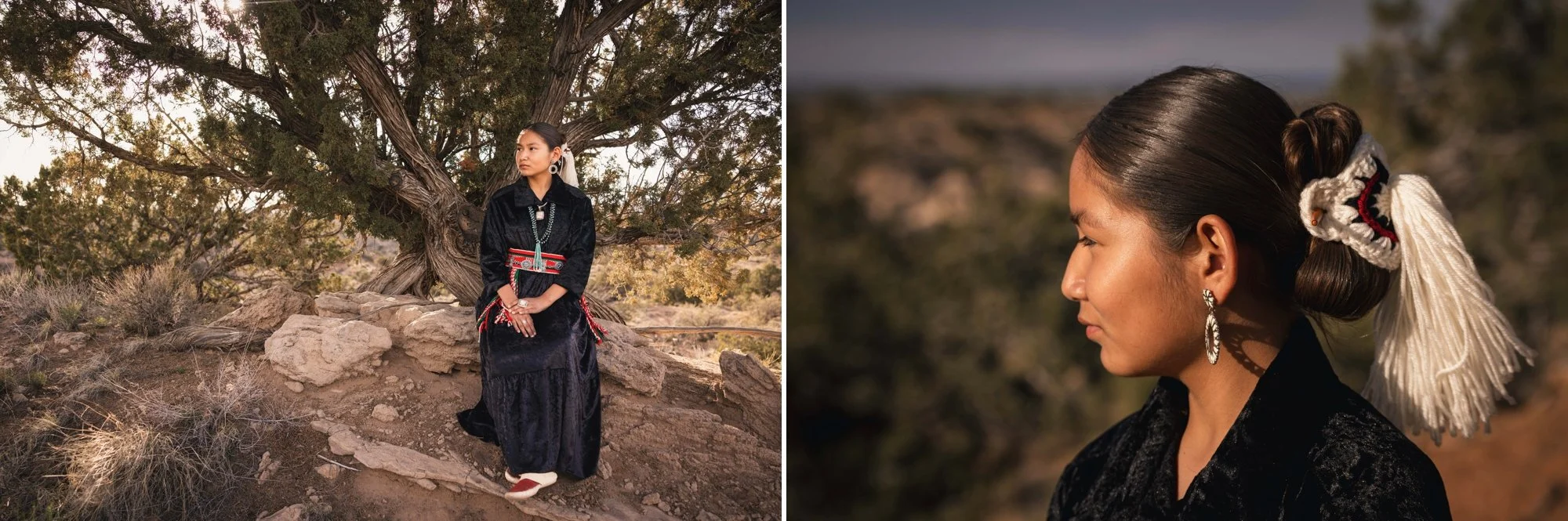
Portraits of Nicolette wearing traditional Diné attire and a Navajo bun, photographed on family land in Ganado, Arizona, for Kim Brundage’s Diné Women Empowerment Series.
Nicolette and the Future of the Story
We began by photographing Nicolette, Tiana’s 10-year-old niece, on her family’s land in Ganado, Arizona.
Her presence brought a different kind of energy into the project — youth, quiet strength, and the beauty of a younger generation standing within the circle of women who came before her.
She wore her hair in a traditional Navajo bun, known as a tsiiyéél.
I learned that your hair has to be very long to wear it this way, and that it takes time and care to gather, wrap, and shape it. It is not a quick hairstyle. There is patience in it. There is intention in it. There is a sense of identity and tradition held in something as personal as hair.
That detail stayed with me.
Because so much of this project lives in the details.
A turquoise necklace.
A young girl standing with a rescued horse.
A desert landscape.
The family land beneath her feet.
A hairstyle that took years of growth before it could be worn in its traditional form.
Photographing Tiana’s niece felt like photographing the present and the future at the same time — a young girl held within the strength of her family, her aunties, her elders, the land she comes from, and the traditions still being carried forward.
She brought youth into the series, but not in a soft or sentimental way. She brought presence. She brought continuity. She brought the reminder that culture is not only preserved by looking backward.
It is carried forward by children.
The Horse Who Was Saved
I also knew I wanted to include a horse.
Tiana has many beautiful horses, and the one we photographed with Nicolette had been saved from the slaughterhouse.
That detail moved me deeply.
I have been learning that horses carry deep meaning in Diné history, story, and relationship to land. They are connected to movement, survival, strength, and spiritual meaning in ways I am still only beginning to understand.
To photograph Nicolette beside this particular horse felt powerful.
A young girl.
A rescued horse.
A desert landscape.
The family land beneath them.
There was something quiet and wordless between them. Something strong, gentle, and unforced.
As a photographer, these are the moments I wait for — when the image becomes more than the elements inside the frame.
It becomes feeling.
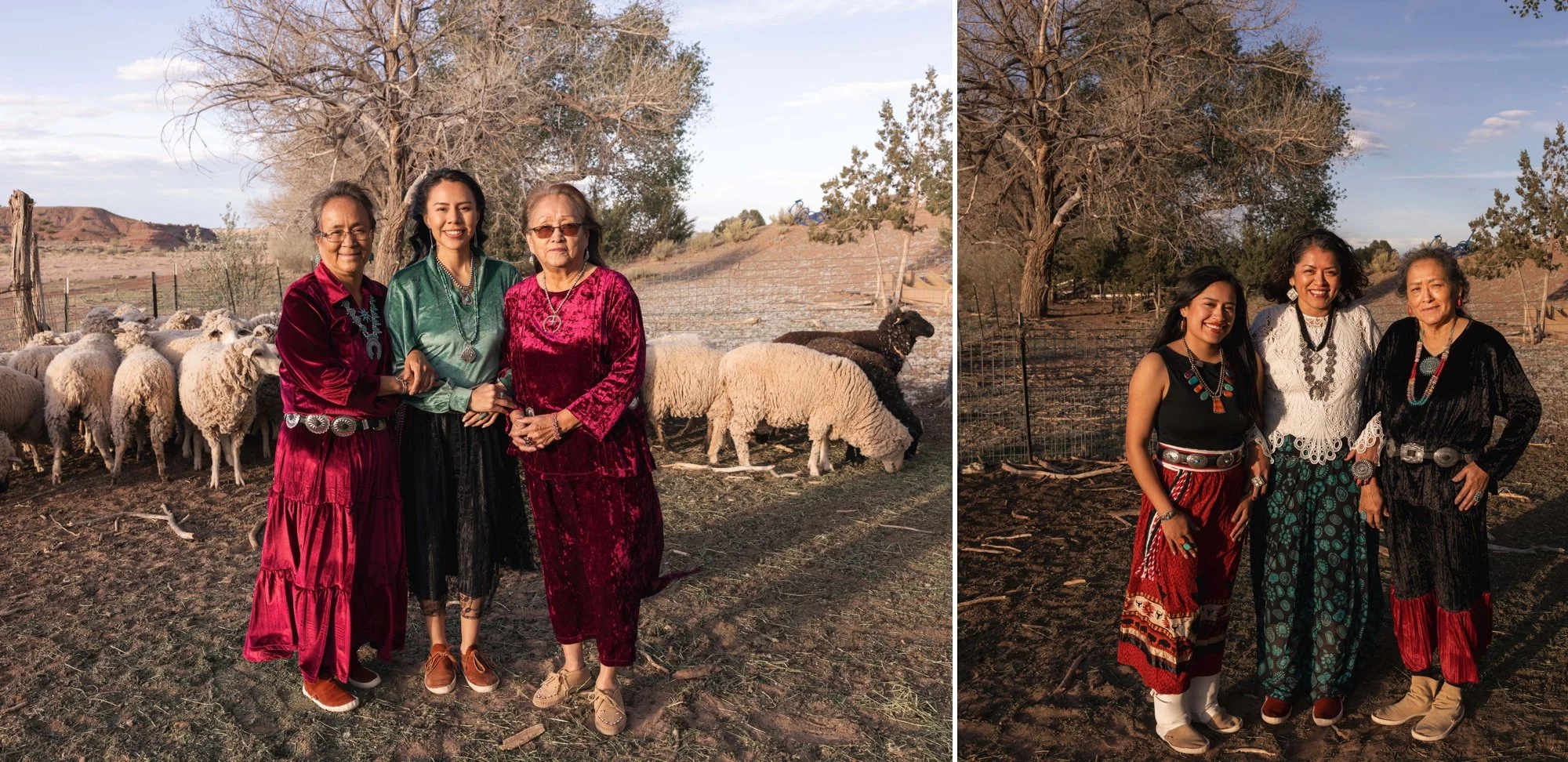
Three Generations of family together in Ganado, Arizona, with sheep.
Why a Multi-Generational Story Mattered
After photographing Nicolette, the story widened just a short distance away.
The women gathered together for a multi-generational portrait with sheep — a young girl, mothers, aunties, and elders standing in one frame on their family’s land in Ganado, Arizona.
That image felt like the larger story I had been hoping the series would eventually hold.
Not just one woman.
Not just one portrait.
But relationship.
Lineage.
Continuity.
Land.
The visible and invisible ways identity, resilience, beauty, and knowledge move through generations.
From what I have been learning and witnessing, elders hold an especially meaningful place in Diné life. They are often keepers of memory, language, teachings, stories, and lived wisdom. In many Indigenous cultures, including Diné culture, knowledge has traditionally been passed down orally — through family, story, observation, practice, and time spent together.
That is part of what made this session feel so important.
A 10-year-old girl stood beside her aunt, mother, grandmother, and elders.
The image was not only about the women in front of me.
It was about what lives between them.
It was about what gets carried.
It was about how family, story, land, and identity are carried across generations.
As a photographer, I am always looking for what is beneath the surface. In this moment, what I saw was lineage.
Not as an abstract idea.
As something embodied.
Held in hands.
Held in posture.
Held in jewelry, hair, clothing, expression, and relationships.
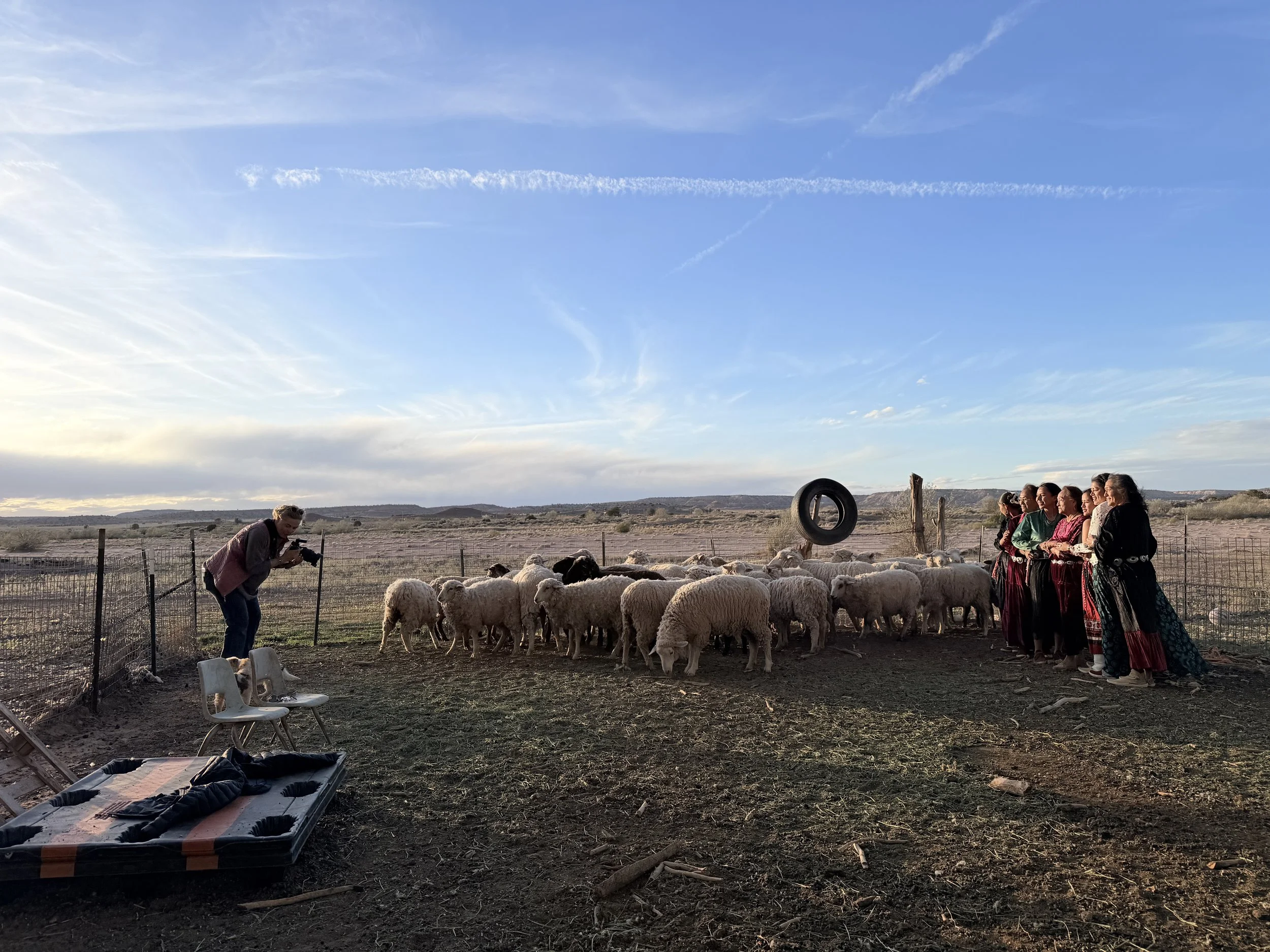
Behind-the-scenes picture captured by my husband, Jeff Dillon, on the family’s land in Ganado, AZ.
The Presence of Sheep
I wanted to include sheep in this session because I have been learning more about their importance in Diné history, daily life, and weaving traditions.
Sheep are not simply scenic or symbolic props. They are connected to livelihood, family, wool, weaving, and cultural continuity.
Navajo weaving is known around the world for its beauty, artistry, and complexity. But what I am beginning to understand is that weaving is not just an art form. It is also a way knowledge is carried.
Through hands.
Through pattern.
Through memory.
Through practice.
Through women teaching the next generation.
Seeing the sheep move through the foreground of these portraits added something I could not have created on my own. They brought motion, texture, unpredictability, and a living connection to the traditions I have been researching.
They reminded me that culture is not static.
It moves.
It breathes.
It interrupts your perfect composition.
And sometimes that makes the photograph better.
The Story of Spider Woman
This winter, while I was in Phoenix, I spent time at the Heard Museum researching Navajo history, weaving, and cultural context for this series.
One story I kept returning to was the story of Spider Woman.
In Diné tradition, Spider Woman is often associated with the sacred gift of weaving. I share that carefully, knowing that these stories hold layers of meaning, and I am only touching the edge of what they contain.
But even from the outside, with humility, I could feel the importance of that connection.
Weaving is not merely decorative.
It can hold a story.
It can hold prayer.
It can hold patience.
It can hold beauty, discipline, family memory, and a relationship to the natural world.
When I photographed the sheep, the women, and the young girl together, I kept thinking about that thread — both literally and spiritually.
The wool.
The hands.
The teachings.
The women.
The generations.
The story is still being carried.
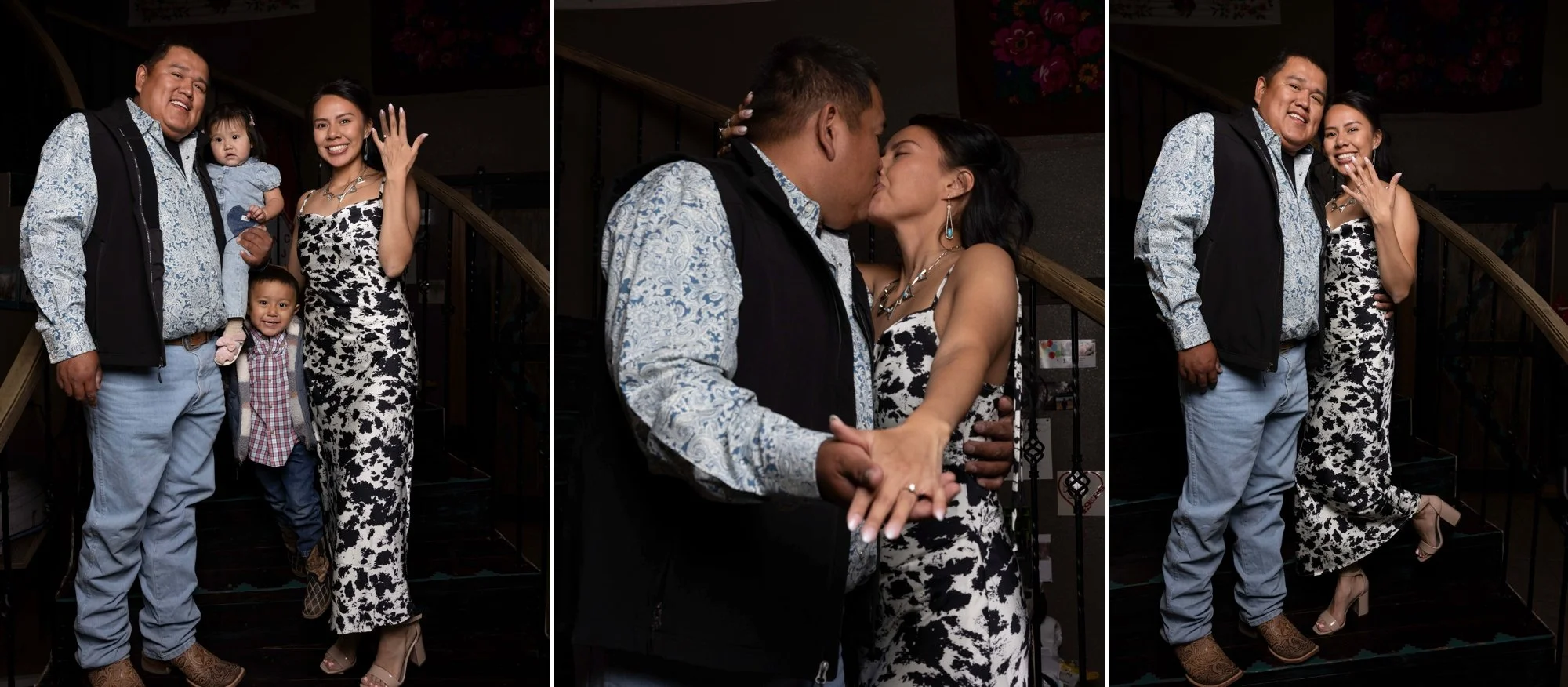
Isaiah and Tiana celebrate their engagement with family after a Diné Women Empowerment Series portrait session in Ganado, Arizona, photographed by Kim Brundage.
A Surprise Proposal
Then the day became even more personal.
Because the whole family was gathered, Isaiah decided to ask Tiana to marry him.
After the portraits, there was a surprise celebration.
It was such a gift to witness that moment.
I had come to photograph a multi-generational chapter in this series, and suddenly I was also present for a family milestone — a moment of love, commitment, joy, and celebration.
I do not take that kind of welcome lightly.
To be invited into someone’s life with a camera is already meaningful. To be present when a family marks a new beginning is something else entirely.
That moment reminded me that this project is not happening in isolation.
These are not just “subjects.”
They are women with families, histories, relationships, laughter, responsibilities, griefs, joys, traditions, and futures.
That is what I hope the portraits honor.
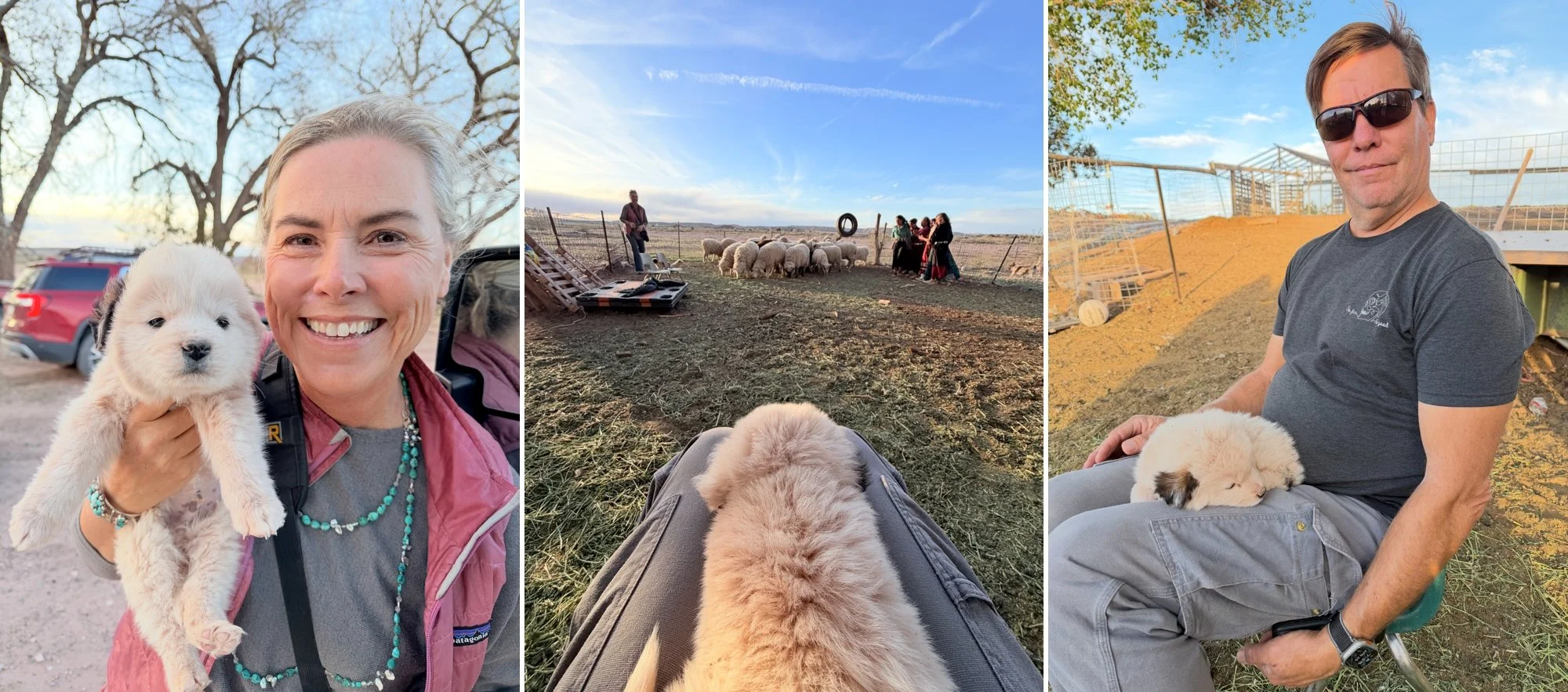
Kim Brundage and her husband, Jeff Dillon, with a rez puppy during a Diné Women Empowerment Series portrait session on family land in Ganado, Arizona, with sheep and family gathered nearby.
The Rez Puppy Who Almost Came Home With Us
And then there was the puppy.
Because of course, in the middle of this meaningful, layered, emotional day, there was also a little rez puppy who completely stole our hearts.
Jeff and I fell in love immediately.
For a brief moment, we seriously considered tucking him inside a jacket and bringing him home with us.
But he was clearly going to grow into a very big dog, and reason eventually won.
Still, he added such joy to the day.
A tiny reminder that beauty is not always solemn.
Sometimes beauty arrives in the form of a fluffy puppy with an irresistible face.
What This Project Keeps Teaching Me
What I feel most is gratitude after this experience.
This project keeps expanding me.
It keeps asking me to slow down.
To research.
To listen.
To ask better questions.
To stay humble.
To understand more of the larger picture of American history — not as something distant or neatly contained in the past, but as something still living in families, land, culture, memory, and what has survived.
Spending time at the Heard Museum this winter gave me important context. I researched Navajo history, weaving, and cultural traditions, and that research has helped me approach this work with more care.
But research is only one part of the process.
Being welcomed into lived experience is something else entirely.
The more I learn, the more I understand how much I do not know.
And I think that is the right posture for this work.
Not certainty.
Not ownership.
Not performance.
But reverence.
Listening.
Witnessing.
And creating portraits with the hope that they reflect the dignity, strength, beauty, and complexity of the women who allow me to stand beside their story for a moment.
Reflection
I am deeply grateful to Tiana, Nicolette, their family, and the women who continue to welcome me into this series.
The Diné Women Empowerment Series is becoming more than I first imagined.
It is teaching me about portraiture.
It is teaching me about American history.
It is teaching me about women, land, family, survival, beauty, and continuity.
I came to create portraits.
I left carrying something larger: a deeper awareness of how culture lives through elders, children, animals, family, story, land, and the traditions that continue to be carried forward.
And I am profoundly grateful for that.
A Few Questions About This Session
What is the Diné Women Empowerment Series?
The Diné Women Empowerment Series is a portrait-based photography project I’m creating with humility, care, and deep respect. Through this work, I am photographing Diné women in a way that honors presence, strength, identity, lineage, land, and story. I am not speaking for Diné people. I am listening, learning, researching, and creating portraits in collaboration with the women and families who choose to participate.
Where was this portrait session photographed?
This session was photographed in Ganado, Arizona, on Tiana’s family land. That mattered deeply to me because the images were not created in a studio or in a place chosen only for visual beauty. They were created close to one another, surrounded by family, animals, land, and the rhythms of daily life.
Who is Nicolette?
Nicolette is Tiana’s 10-year-old niece. I photographed her first during this session because I realized the series needed a young girl to help tell a fuller, multi-generational story. Her presence brought youth, quiet strength, and a sense of the future into the work.
Why were sheep and horses included in the portraits?
I included sheep because I have been learning more about their connection to Diné history, daily life, wool, weaving traditions, and cultural continuity. I included a horse because Tiana has many beautiful horses, and the horse photographed with Nicolette had been saved from the slaughterhouse. Both brought a deeper sense of land, relationship, survival, and meaning to the portraits.
What made this session especially meaningful?
This session brought together many layers: a young girl, elders, family land, sheep, horses, cultural learning, and an unexpected family milestone when Isaiah proposed to Tiana. I came to create portraits, and I left having witnessed love, family, continuity, and celebration.